
Rising seas mean less beach. Some of South Carolina's greatest beaches are already largely underwater at high tide. Rising seas also mean that more sand will be washed away from our beaches. To deal with this erosion, communities often renourish their beaches (in other words, deposit more sand from somewhere else). Unfortunately, this practice is costly and only temporary. In fact, beach communities in South Florida are now facing a sand crisis; they are running out of places to find the relatively cheap offshore sand that they have historically used for renourishment.
Here in South Carolina, we have spent hundreds of millions of dollars on beach renourishment and there is no end in sight. Read below to learn more about renourishment projects in SC.
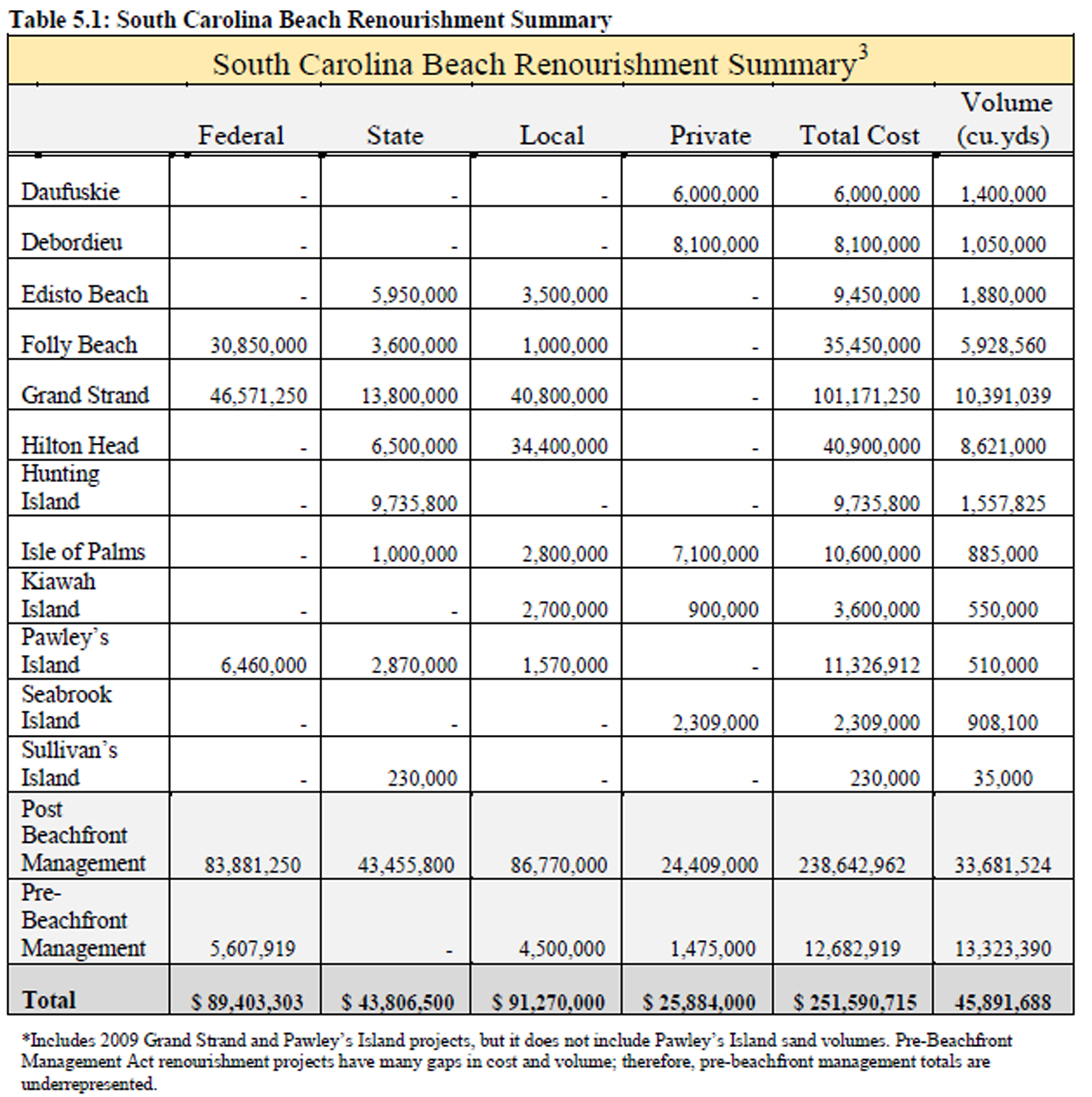 [i]
[i]
Hilton Head: 3 large-scale projects since 1990 (1990, 1997, and 2007) and has another one in 2011-2012 ($9.8million). So their timeline shows necessary renourishment every 4-10 years
Folly:
- Federal gov pays for 85%, city pays 15%
- City has specific funds ($1.61 million to date) set aside for renourishment – city has been putting in $150,000 annually
- Folly Beach County Park has been renourished in 1993, 1998, and 1999
- 1993: 1.9million cubic meters of sand over 8,600meters of shoreline and cost $8.9million; done by Army Corps of Engineers
- 1998: fed gov paid $315,000 to renourish with 90,000 cubic yards of sand – reason gov paid was b/c they determined the erosion was due to the Army Corps 1993 project
- 1999: Army Corps paid $228,000 to dredge 49,000 cubic yards of sand from Folly River to use at Folly Beach County Park